
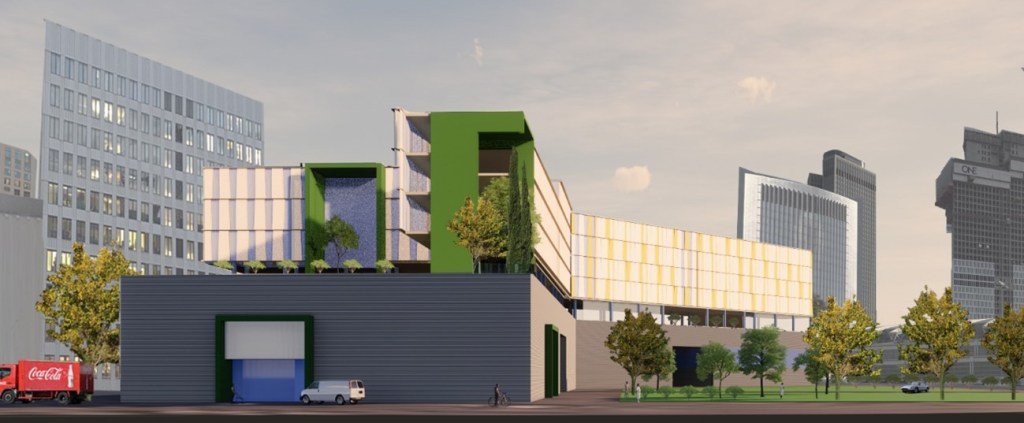
During the last century huge efforts have been made with political reforms and medical research. As we learned at school, as a consequence of this the world population has begun to grow steadily more than 120 years ago and it is this still without reaching its peak. Population on earth has doubled since 1970 and there is a series of developments resulting from this fact.
Looking back to the past, many children did not reach the age of five for bad medical and hygienic reasons. A high percentage of the population died with wars, hunger or diseases until 1918. Harari points out at „Homo deus“ that after replacing hunger, infections and wars at the top of human agenda the “new central project will be to protect humankind and planet as a whole from the dangers inherent in our own power.” Harari, “Homo deus”
Bringing these three threats under control was possible thanks to a phenomenal economic growth, which provided us with sufficient food, medicine, energy and raw materials. “Yet this same growth destabilizes ecological equilibrium of the planet in myriad ways which we have only begun to explore.…” Harari, “Homo deus” p.22

The good news that we live longer with a reduced infant mortality rate leads to different trends worldwide:
- Population´s median age is higher than ever in the more devolped countries and women decide to have less children at a later stage of their lifes
- In the emerging countries we observe an important population growth when this is not regulated (example: Egypt). The main part of the population is young at these countries.
- In the emerging countries with birth control regulations we observe a steady population growth with a peak in a very close future (example: China)
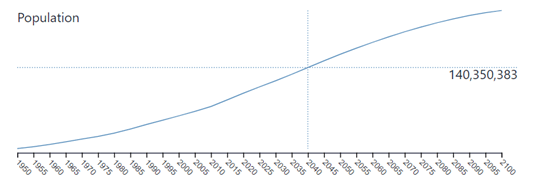
When it comes to study the emerging countries we observe in Northern Africa a clear population growth that demands more water, more energy, more residences and more food.

“In the upcoming years, Egypt’s growing population will provide additional challenges to its already limited resources, social stability and economy. Accordingly, in 2018, the Ministry of Social Solidarity launched a two-year project called 2 Kefaya (Two is enough) …in order to get curb the number of children in Egypt, particularly in the most populated areas.” Sara Ahmed, Egyptianstreets
Egyptian population is expected to more than double from the year 2000 to the year 2040, that means growing from now on with 2.000.000 habitants per year (in comparison the U.S. will grow 1.000.000 habitants per year starting from a higher base).
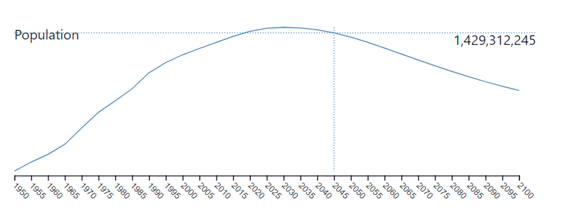
China, the most populated country on earth, is an emerging country with birth control regulations since Mao Tse Tung. In direct comparison, the Chinese population is expected to reach its peak in 2030 and then will decrease.
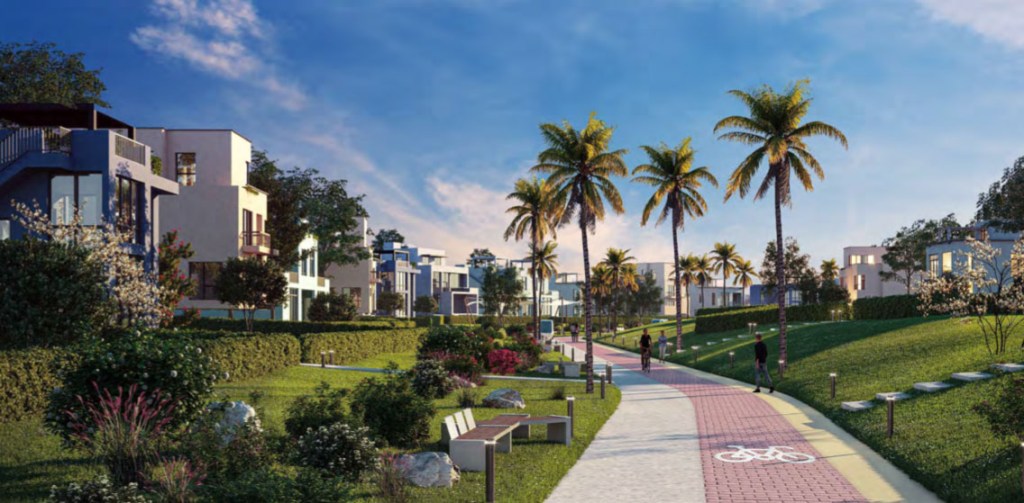
However, both countries are investing in concrete as much as they can during these years. Designing tenths of thousands of m2 of residential use is positive for the cement industry but not optimal for the country´s CO2 balance. The feel of lack of sustainability motivates the designers of these blocks to include green features to the images of the sales brochures.
Both countries with completely different climates and water resources promise sustainable approach: a landscaped future. Lush gradens and green facades wherever you look.

What might be plausible at a wet climate such as in subtropical Indonesia, becomes surprising when you face the MENA countries design brochures. It is obvious that the green has become a marketing instrument to enhance the sales these days. Here, the question must be: do we really have sufficient water for such amount of Green and Golf facilities?
Richard Attenborough points out at his emotive movie „Planet Earth“ that we cannot ignore the changes and that the world needs to become „wilder“ again to find back to its natural balance to enable the habitat to reconquer the space.
So is there anything wrong in applying green facades?
Apart from marketing considerations there are without any doubt good intentions behind the intent to apply green facades and to recycle existing blocks adding trees and greenery at their facades.
There are many iniciatives to green up the cities, but it seems to be not always a balanced approach. Shareholders wish currently to make a strong gesture – however all the aspects need to be analyzed as the following example shows.
The Dream of the Green
In 2020 a group of designers was commissioned to study the refurbishment of the current hospital main facade. It included opening lobbies for visitors with intermediate decks to gather and wait. Terraces for eateries and lounges were briefed to create a flowing transition between the more technical not accesible zones (back of the house) with the full publically accessible areas (front of the house). All this embedded in the desire to convert the hospital into a service provider and to convert the patients and the visitors into potential customers. Dressing this old block in a city located with a new skin, the energy efficiency was supposed to meet current standards and to obtain a certain certification ensuring that the architectural qualities of the building would be retained.
After the first design ideas presentation to the hospital board, the owner literally expressed: „Don´t be shy! Make it more green!“ triggering by this means a series of studies that are interesting enough to be reflected at these pages. We went back to the offices and started to think and to draft first ideas.
Round 1 – The Landscape approach
We proposed at street level a rich landscaped option as we believed, relating our precedents to a long history of lawns from the Chateau Chambord to the White House in Washington.
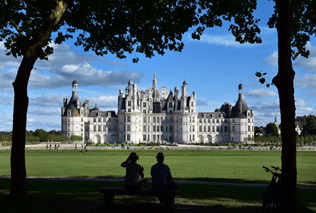
We learned from the books that a proper turf in front of a castle was an expression of power and wealth since the Baroque times. Only the mightiest emperors and kings could afford to spend so much energy and resources to maintain the lawn between the trees.
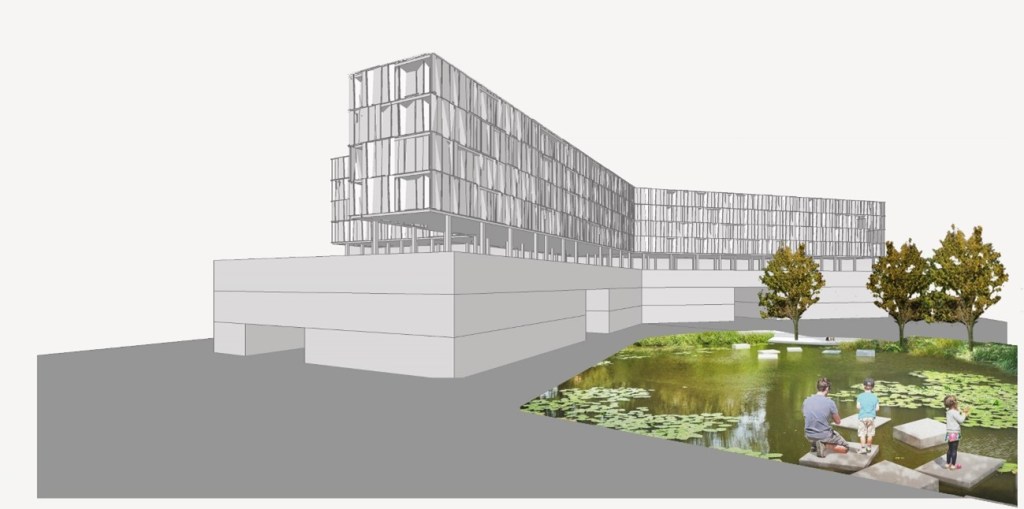
So we proposed a nice garden and a lovely pond at street level. – „That´s not enough!“ was the prompt reaction. „We need the space at access level for so many other uses related to traffic, reception, emergencies and retail. Add green at a higher level!.“
Round 2 – The Hanging gardens approach
We proposed to make some hanging gardens from a green roof ignoring all the climatical concerns from cold winters to hot and dry summers. Again, we prepared a few panels and shared these ideas with the client.
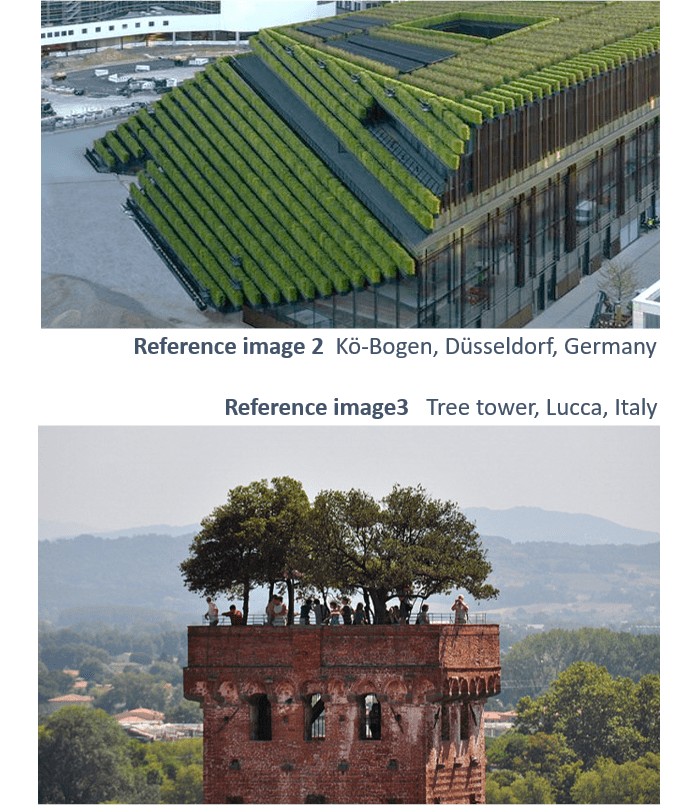
„Sufficient green, yes, but what about the maintenance of all that plants? Can we really afford to cover the windows with greenery? What about the views? It is a hospital and it must be functional and easy to clean.“
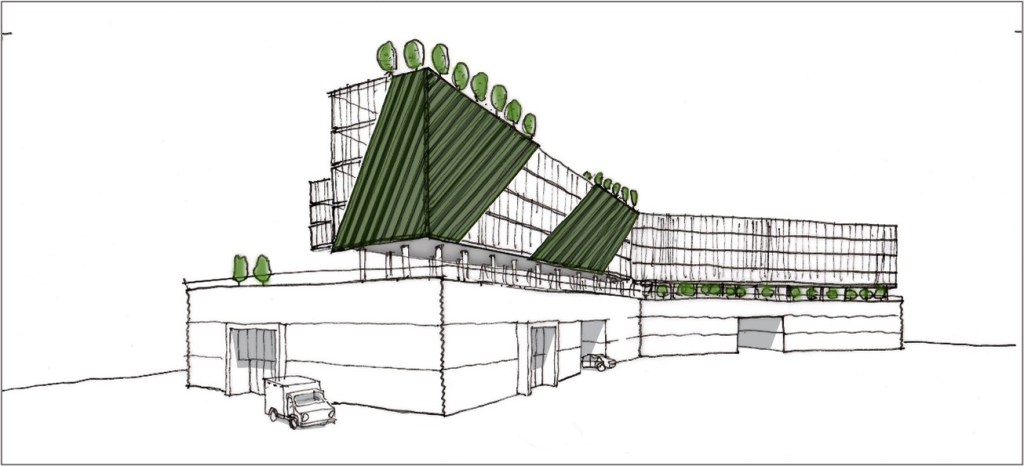
With respect to the green roof the reply was. „We like the image very much, but consider that nobody will be allowed to go up to the roof! It´s too dangerous and full of machines there!“ It was clear that this was going to be a interesting design process.
Round 3 – The Green wall
We proposed to build huge green walls around punch hole openings and to add green at the inner voids and to have small trees at the intermediate joint.

„That´s looking nice and the other hospital group went into into this direction. However, patients complain about insects and the water consume has doubled for the hospital management.“
We understood that this approach requested intensive care, time and money. „Gentlemen, we will not spend all that money – not visible from a distance. Better learn from the mistakes of the others. Keep going!“ So, we went back to make another intent.

Round 4 – Deck and Frames
There was a long discussion about the pros and cons of green at buildings concluding the research with introducing a garden with strong trees and a minor number of smaller trees and shrubs at upper terrace level for patients and for the visitors. Adding a flower shop and a theme of frames that indicates vehicle access gates and reception points.

The designers conclusion was: humankind needs to be optimistic to find the water that is needed to satisfy the still growing world polulation. As Richard Attenborough points out in his dramatic last movie, it is later than five to twelve, and homo sapiens is about to destroy the natural habitat by reducing forests and by generating CO2. It seems to be more than logical in this context to find solutions to recycle and to enhance existing buildings within the cities and to add trees and vegatation that converts CO2 into oxygene with photosynthesis.

Madrid, December 2020
 arkollective.com
Me ha encantado. Pero cual es la conclusión? Arbolitos? Quiero añadir que con la crisis climática que hay a qué viene que se gasten todo el dinero en 5G? Esto es peor para la Tierra por todos los metales raros que se necesitan para stock all this virtual información
LikeLiked by 1 person