

Form follows function
‘’Form (ever) follows function’’ is a famous a motto attributed to the American architect Louis Sullivan who lived until 1924. Nonetheless, the architectural concepts behind this short sentence were considered gospel truth until the second half of the XX century and many designers still follow some of its principles today.
The core idea here is that a building would be more beautiful and, most of all, truthful, if conceived and designed mostly based on its practical needs. It implies an ethical approach to the conception of buildings that would also lead to the disappearance of classical references and the removal of the ornament.

In a different layer of interpretation, we can also read in this sentence the principle of ‘’container’’, whereas each function belongs in its own space and place. In its end result, the building can become an additive accumulation of functions with each of them being expressed in the final form of the total object.
Many times the outcome became a beautiful display of volumes merged dynamically with the elements that inter-connect them, such as stairs, lifts or overpasses.
The merging of functions
Since the prophetic phrase was written, architecture went through multiple changes. Some of the present currents still take it as true and apply it in more complex and sophisticated manners, other simply ignore it or, mostly, question it.
The emergence of the Internet and GSM technology brought great changes to the ways we use space. As an example, consider the manner in which work invades your leisure times with notifications and emails through your smartphone. The division between private life and work life is more blurred than ever and so are space boundaries.
Working from home became a trend in the last decade. The Corona virus pandemic only pushed that trend to become part of the ‘’new normal’’. Your house is your office, your kids’ school, your gym, etc…
But beyond the unexpected effects of this pandemic, the trans-functional revolution was already happening a long time ago. The idea behind it is basically the need to reformulate the way we use and experience a determined space or a building as a whole.
Trans-functionalism (Blurring the edges)
New trends in work psychology acknowledge that being at the office cannot be just performing tasks in front of a personal computer. Such branches of the so called social sciences influence more and more workplace design and invite architects to reinvent the environments where people spend most of their time.
This involves introducing other (new) functionalities that co-habit with the core activity of an office space and add diversity and flexibility into the workers daily life. The main purpose is not simply making people happier or more productive, but to make them forge better relations and build a sense of belonging.


Co-work spaces do this very well since there is no employer behind the design concept of these venues. They invest more on the ‘’spaces between’’ than in the work space itself. And this transformation has been happening in corporate buildings as well.
Introducing open air green areas or a library, a large kitchen or a sports court on the roof can simply redefine the whole logic of the workplace without making it less of a workplace.
Similar approaches are taking place in residential projects, quite different from those proposed in the bourgeois compounds with lawns and pools appealing to laziness we can find in the city suburbs. The next step involves functions that might offer you a place to relax but also to work, to create your own urban farm or to debate the issues affecting your neighborhood.
Basically what is occurring is that the boundaries for working or living are being blurred, with the space of isolation being reduced and becoming more integrated with other functions for socializing, networking and short term leisure. These other functionalities are now becoming central in new design concepts in a consistent denial of a mono-functional approach.
Beyond the Building

Never a building is disconnected from the ground, nor is its impact confined to its boundaries. The physical presence of a built object influences the way we experience its surroundings and close environment. The people who inhabit and use its spaces bring the energy and pulse that ignites our cities or landscapes.
More than ever, designers are getting conscious of this dimension and develop solutions that extend the core functions of buildings beyond their physical limits. An ambitious project acknowledges this and proposes solutions through design that extend the impact of the building as much as possible into the city and transforms the ways we experience it.
If in the ‘’form follows function’’ culture a factory is just a factory, in trans-functionalism, a factory can be that and much more.
Recent projects such as the Amager Bakke power plant (a.k.a Copenhill) by BIG (Bjark Ingels Group) in Copenhagen where a large industrial facility is simultaneously used as a public park and a ski slope, are examples of such approach. Besides the energy it produces the factory building also returns back to the citizens an exciting and unique experience by originally adding other functionalities – apparently apart from the original purpose of the building – that made it a successful gathering place as well as an icon to the neighborhood and the city.


If in the ‘’form follows function’’ culture a factory is just a factory, in trans-functionalism, a factory can be that and much more.
In that sense, BIG, since the publishing of their book-‘’manifest’’, Yes is More – another motto inspired by an even more famous motto – has been pushing architecture to add a great diversity of valences to buildings, urban infrastructure or landscape proposals, always with the ambition of offering more than is usually expected from them.
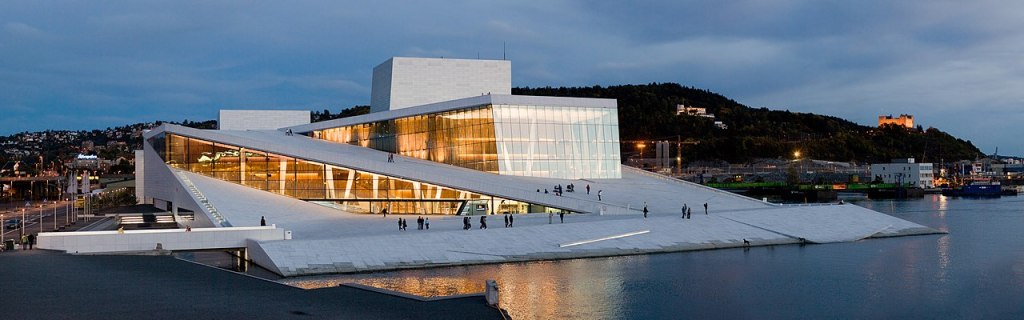
Another example could be Snøhetta’s uber famous Norwegian National Opera and Ballet in Oslo. With similitudes with the Copenhill but built around 10 years before, in this building the roof was also used as an element for public experience and expanded fruition of Oslo’s harbor and fiords.
Another even more interesting aspect in this project is that the lobby areas are of free public access 24 hours a day. The architecture firm refers to it as a keyless space or structure. This means that the interior and exterior spaces around the building blend easily, making those areas part of the city.
Adapting Vs. Imposing
All these transforming aspects in architectural design are the result of both a technological and social revolution. The XXI century civil society reveals more concerns towards the quality of the environment – natural and social – which generates more capacities from the spaces designed by architects. By demanding more diversity, flexibility and adaptability users are also asking for more democracy. People are not all the same, nor do the same things, and for buildings to be inclusive they need to incorporate that universal diversity in ways that communities can thrive.
With this in mind, architects will be empowering the user for having a leading and constructive role in the life of a building.
This can be mostly achieved through the appropriation of the space. In such case, the user is given the capacity and freedom to, up to a certain extent, of course, mold and adapt the space for the purposes he/she is looking for.
Building design, instead of imposing the ways for its use by overdesigning, compartmenting and defining strict functional principles, should create a margin for the intervention of the ones who are going to be the true inhabitants of the space. As the bottom line, the building becomes most of all a support for the activities taking place inside it.
With this in mind, architects will be empowering the user for having a leading and constructive role throughout the life of a building.
 arkollective.com