

Don’t let it rot. Save it.
By Burak Kuru
You have been living in Istanbul for a while, for about 5 years, what was your reason for coming to Istanbul? Can you give us some information about yourself?
Actually, it is now more than 6 years since I came to Istanbul in the summer of 2014. The main reason is personal. My wife is Turkish and we were living abroad when she was called back to Turkey. By then, this country was in an economic counter-cycle. While the West was still dealing with the consequences of the 2008 crisis, Turkey had a booming economy. I am an architect, so there were very good opportunities to work here. I would also add that there was an idea that along with economic success, social and political changes were going to happen… I have been living and working here since then. Istanbul is a very complex place and, as an architect, that engages me to learn and research on the many aspects of its multifold facets.
I am curious about your observations about the city. Like your hometown Lisbon, Istanbul is a city of seven hills (Yeditepe). Can you talk about the similarities and differences?
Indeed there are similitudes. Both are very old cities, with an extremely rich past that can be read in the people’s personality and the way they live, in the buildings, in the food… Istanbul and Lisbon are port cities, close to big water communication channels; this made them open to changes and differences, adaptable and always transforming. Places for an interchange that has been going on for thousands of years. If Istanbul gives me all this blend of Mediterranean, Caucasian and central Asian culture, Lisbon mixes its European roots with all that comes from the privileged relations with Africa, Brazil and the Far East.
The main differences I would point out relate with scale. Lisbon is a 3 million people city while Istanbul has 16! Lisbon is not small but it has an ideal size to have a bit of everything. This translates into a more balanced way of life, both in the manner you can experience the territory as in the social opportunities. Istanbul has enormous socio-economic breaches that range from multi-millionaires to extreme poverty. It’s a megacity with many contradictions, it offers the best and the worst of humanity.


In Lisbon, urban transformation was carried out and it received great reaction due to gentrification. Urban transformation in Istanbul is also seen as gentrification, as the regions are renewed, those who used to live there can no longer live. What do you think Turkey is doing incorrectly in urban transformation?
Well, organic gentrification has positive and negative sides. On one hand, it provides transformation/renovation where the public stakeholders don’t seem willing to operate. On the other, as it happens due to unregulated property market conditions, prices rise, thus generating enormous socio-economic pressure on the less privileged. And this happens in Lisbon, Istanbul, New York or Buenos Aires.
In Turkey, there seems to be an absence of a ‘’bigger picture’’ perspective when many of the structural projects are approved. Cities like Istanbul or Ankara grow exponentially through huge public and private investments pushing, deforming and enlarging the territory beyond its real needs. And this really affects people’s quality of life when you don’t have proper public transportation, for example.
In Istanbul, take how the E5 highway has been populated with high rise buildings along its Asian and European trajectory. This West-East axis was already saturated with millions of cars when I arrived here. Nowadays, it’s almost impossible to circulate due to the amount of people using individual transportation to access the new business centers, hospitals, malls, etc. spreading along. Similar things happen in Ataköy, Maslak or Medicidiyeköy. The strategic territorial planning should become more concerned with the quality of life of the istanbulites, in its environmental, social and public-health dimensions.

There are so many unfinished buildings in Istanbul. For different reasons those buildings were left to rotten. And you have a project which brings a different approach, a different solution about what to do with these incomplete buildings. Do you think your project will draw any attention by the authorities?
This project I have developed together with my architect friend and colleague, Uğur Yavuz, comes mostly as a speculation and somehow a provocation to both institutions and civil society. All of us are responsible for what happens in our cities. Besides publishing it in our blog, arkollective.com, we are sharing it with institutions and other media outlets, aiming to promote a constructive debate. In the media it generates interest for its positive and transformative approach. On the institutional side, we have been willing to work and share our point of view in order to trigger more concrete actions.
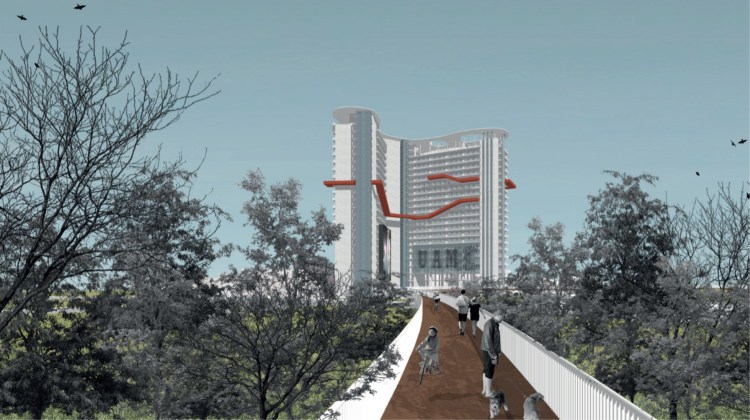
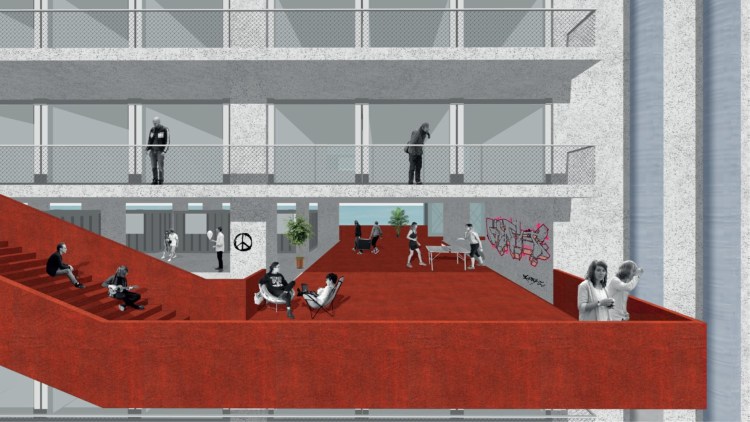
It really caught our attention the quantity of canceled large projects throughout the city and the passiveness that we co-habit with them, as if it is something normal. So we started to gather information about many of those buildings and publishing it in the blog. Then we evolved to the Life of Abandoned Buildings, with the purpose to put a light on the subject but also adding a regeneration proposal, making it more tangible. We used an abandoned structure existing in Hacıosman for more than 20 years – the Grand Prestige Istanbul Hotel – and developed a design concept that would totally redefine the area. Uğur and I investigated the context deeply and developed an inclusive design proposal that aims to build communities through education, culture, sports and its connection to the surrounding forests. It’s a big contrast with the ‘’black hole’’ we have there today…

Can you talk a little bit about examples of such structures in the world? Where proposals made by civil initiatives are implemented and presented to the public interest?
I think the most famous example worldwide is the High Line in New York. This was an old elevated train rail in the Meatpacking district, which was about to be demolished after many years of abandonment, and was rescued thanks to the action of a non-profit association established by neighbors and enthusiasts. After a long process of discussions with public authorities, the demolition was canceled and it became a linear park which attracts millions of visitors and created a new way to experience this area of the city.
I can also tell you about the LxFactory in Lisbon. This was an abandoned XIX century industrial complex in the city center that was slowly occupied by creative industries with the consent of its private owners. Later, retail, restaurants and nightclubs also joined. Together, they were responsible for the refurbishment of the areas they were occupying as well as of the common and public spaces. In the end, it became an uber-trendy place that no one misses in the city.
So these are two different alignments involving civic movements, public stakeholders and private owners. All is possible; we only need the critical mass.
Earthquake is Turkey’s most important problem. Disaster scenarios are written for Istanbul for a possible Marmara Earthquake and these are supported by scientific data. How do you think such projects, proposals, can be adapted during a time of crisis?
It is an important issue indeed. No re-use of such buildings could take place without the proper requalification and reinforcement of their structural qualities, ensuring maximum safety. This is costly, but feasible. The added value of thinking of reinvesting in such buildings lies also in the interest that it can generate in the real estate market. The fact that they are already there, that they have a history in people’s day-to-day memories, makes renovation more appealing and surprising. If their sad condition turns into something good for the community, the neighborhood or the city, imagine the success!

“We think that if owners cannot take care of their assets and leave them abandoned with a negative impact on public health and the quality of the built environment, the right of use of these properties should be taken over by public agents. They would bear the responsibility of transforming them and giving use for the benefit of the citizens.”
These words are from your introduction of project. We also have houses in İstanbul’s Fikirtepe District, do you think that, we should adapt your idea for houses?
Well, this is the provocative side of our approach because we know that it is a very delicate issue. But we can imagine and propose methodologies. A possible solution would be the public institutions creating the governance tools or task forces to act together with the private owners in order to promote the necessary change. And, within a positive perspective, generate the necessary context for a win-win situation for the city and the population but also for investors. But, as I said previously, the citizens should also speak their minds and express their opinion without fear.
Regarding your question, if you refer to the gecekondu (”overnight” self-built constructions) type of construction, the idea behind our concept is hardly applicable. Why? First, it relates to what you just pointed out, security. Gecekondus are illegal in its nature. Their construction was neither subject to any regulations nor performed within qualified professional procedures. Second, these are very small properties, which were probably subdivided in even smaller units. That makes it very hard to control and achieve easy decision making. The construction with illegal genesis in Turkey needs a much deeper action plan because it puts people’s lives in danger. Proof of that are the dramatic consequences that we could observe in Izmir’s recent earthquake and the ones that occurred previously.
Fikirtepe is also going through a large renovation process which, in my point of view, takes a direction apart from the contemporary way of making city. Although it is safer than the gecekondu areas, it is built out of greed for the square meter and destroyed all the previously existing vicinity bonds. There is so much density that sunlight barely passes between buildings, green and social spaces are almost inexistent and we can go on pointing out all the faults…
Istanbul’s greatest capital comes from its background as a place for sharing, exchanging and reinventing. Us, who live in this unique place on earth, should honor that legacy.



 arkollective.com
Read it all! Excelent! Congratulations! Good years ahead for Istambul and all those who care!
LikeLiked by 1 person
So glad you liked it and thanks for the support!!
LikeLike
I like very much the reading of your interview. Congratulations dear John. I hope that your interesting idea would be a ssuccess.
From Lisbon to Istambul with love
LikeLike
Obrigado!!
LikeLike
Boa Mike
Enviado do meu iPhone
LikeLike