
Covid-19 and public transport
“All around us are people, of all classes, of all nationalities, of all ages.” Murder on the Orient Express, Agatha Christie

“It was five o’clock on a winter’s morning in Syria. Alongside the platform at Aleppo stood the train grandly designated in railway guides as the Taurus Express. It consisted of a kitchen and dining car, a sleeping car and two local coaches.
By the step leading up into the sleeping car stood a young French lieutenant, resplendent in uniform, conversing with a small lean man, muffled up to the ears, of whom nothing was visible but a pink-tipped nose and the two points of an upward curled moustache.
It was freezingly cold, and this job of seeing off a distinguished stranger was not one to be envied, but Lieutenant Dubosc performed his part manfully. Graceful phrases fell from his lips in polished French… “You have saved us, mon cher,” said the General emotionally, his great white moustache trembling as he spoke. “You have saved the honour of the French Army—you have averted much bloodshed! How can I thank you for acceding to my request?” Murder on the Orient Express, Agatha Christie
Thinking about train stations makes me recall wonderful moments of my childhood: exotic aromas, wagons dressed in wood and satin and the smell of smoke at a busy strain station.
Long-distance passenger trains service created in 1883 by Compagnie Internationale des Wagon-Lits were a showcase of luxury and comfort at a time when travelling was still rough and dangerous. Several routes in the past concurrently used the “Orient Express” name, or slight variations. Although the original Orient Express was simply a normal international railway service, the name became synonymous with intrigue and luxury travel. The two city names most prominently associated with the Orient Express are Paris and Constantinople the original endpoints of the timetabled service.
Wenn ich an Bahnhöfe denke, erinnere ich mich an wunderbare Momente meiner Kindheit: exotische Aromen, in Holz und Satin gekleidete Wagen und der Geruch von Maschinen in einer belebten Bahnhohshalle.
Der 1883 von der Compagnie Internationale Wagon-Lits ins Leben gerufene Personenfernverkehr war ein Schaufenster von Luxus und Komfort in einer Zeit, als das Reisen noch rauh und gefährlich war. Mehrere Routen in der Vergangenheit verwendeten gleichzeitig den Namen „Orient Express“. Obwohl der ursprüngliche Orient Express einfach ein normaler internationaler Eisenbahndienst war, wurde der Name zum Synonym für Intrigen und Luxusreisen. Die beiden Stadtnamen, die am prominentesten mit dem Orient Express in Verbindung gebracht werden, sind Paris und Konstantinopel, die ursprünglichen Endpunkte des Streckendienstes.
Das Ende des 19. Jahrhunderts war gekennzeichnet durch ein rasches Wachstum des Eisenbahnnetzes. Das Beispiel Köln.
So wichtig der Rhein als Fluss für den Güterverkehr zwischen Basel und Rotterdam auch war – er stellte ein grosses geographisches Hindernis dar zwischen dem Reich der Franken im Westen und Germania im Osten des Flusses. Den Aufzeichnungen nach gab es seit der Gründung Kölns als Limes-Festung der Römer bis zur Schaffung des deutschen Eisenbahnnetzes in Köln keine Rheinbrücke! Erst 1859 und mit zunehmendem Einsatz von Stahl an Hochbauten wurde die Hohenzollern-Brücke errichtet und als Verbindungsglied für links- und rechtsrheinischer Eisenbahnabschnitte vorgesehen.
Der noch nicht fertiggestellte Dom zu Köln sollte mit finanziellen Mitteln Preussens zum Abschluss gebracht werden. Tatsächlich fielen der Bau der Stahlbrücke und die Fertigstellung der Kathedrale in die gleiche Epoche – die Einweihung der Kathedrale wollte Kaiser-Wilhelm sich nicht nehmen lassen. Deshalb wurde als grandiose Inszenierung der Einfahrt, der Legende nach, diese erste Kölner Brücke exakt auf die Mittelachse des Doms ausgerichtet, was dazu führte, dass der Hauptbahnhof Kölns unmittelbar neben der Kathedrale errichtet wurde.
Die rasante technische Entwicklung ging wie wir alle wissen einher mit der Industriellen Revolution. Es folgten politischen Umwälzungen, die Schüsse auf Erzherzog Franz Ferdinand in Sarajewo, Kriegserklärungen, Mega-Inflation und schließlich die beiden Weltkriege, die viel Leid über die Welt brachten.

The end of the 19th century was marked by reapid growth in the railway network - the example of Cologne, Germany: as important as the Rhine was as a river for freight traffic between Basel and Rotterdam, it represented a major geographical obstacle between the empire of the Franks in the west and Germania in the east of the river. According to the records, there was no bridge over the Rhine between the founding of Cologne as a Limes fortress by the Romans and the creation of the German railway network in Cologne! It was not until 1859, and with the increasing use of steel in high-rise structures, that the Hohenzollern Bridge was built and intended to connect railway sections on the left and on the right side of the Rhine river.

The not yet completed Cologne Cathedral was to be completed with financial resources from Prussia. In fact, the construction of the steel bridge and the completion of the cathedral fell in the same era - German Emperor Wilhelm II did not want to miss the inauguration of the cathedral. Therefore, as a grandiose staging of the entrance, according to legend, this first Cologne bridge was aligned exactly with the central axis of the cathedral, which led to Cologne's main train station being built right next to the cathedral.
As we all know, the rapid technical development went hand in hand with the industrial revolution. This was followed by political upheavals, shootings on Franz Ferdinand in Sarajewo, war declarations, mega-inflation and finally the two world wars, which brought much suffering to the world.

Nach dieser Zäsur kam die Wiederaufbauzeit Ludwig Erhards und mit ihr entstanden moderne Intercitysysteme mit entsprechenden Bahnhöfen, die sowohl in England als auch in Zentraleuropa die Bahn zu einer komfortablen Alternative zum Individualverkehr machten.
Mit dem „Wirtschaftswunder“ kam der Linienflugverkehr auf. Es gab nicht nur Vollbeschäftigung und Massentourismus (Urlaubsreisen mit dem Wagen in den Süden Europas), sondern auch erste Schattenseiten des neuen Wohlstandes in Form von Drogenkonsum, der sich oft an Bahnhöfen abspielte, und diese in wenig attraktive, verwahrloste und gefährliche Orte verwandelte.
„Wir Kinder vom Bahnhof Zoo“ entstand als wichtigster Film, der die Kinderprostitution in der Heroinszene am Zoologischen Bahnhof der verwaisten Hauptstadt Deutschlands porträtierte. Untermalt von David Bowies „We would be heroes“ schauten wir auf verschmutzte Bahnhöfe die zu sozialen Brennpunkten verkommen waren. Was gegen Ende des 19. Jahrhunderts so ruhmvoll begann, lief 90 Jahre später in eine Sackgasse von Elend und Drogentot.
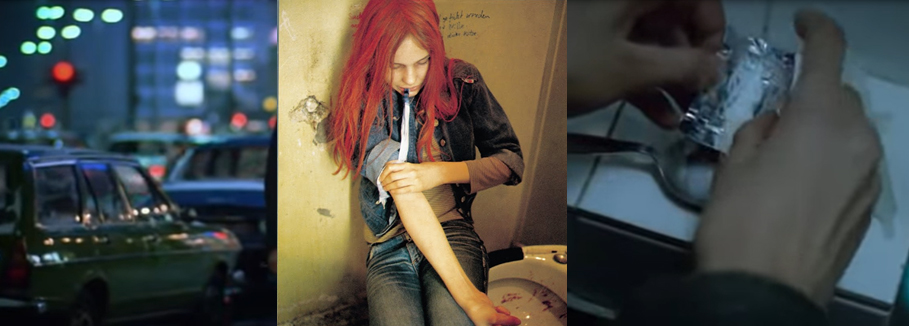
After the war came the reconstruction of Ludwig Erhard and with it modern Intercity train systems were created, which made the railway a comfortable alternative to private transport in England and on the continent.
With the economic miracle the scheduled air traffic came up. There was not only full employment and mass tourism by car to the south of Europe, but also the first downsides of the new prosperity occurred in the form of drug use. This often took place at railway stations and turned them into unattractive, neglected and dangerous places.
“Wir Kinder vom Bahnhof Zoo” was the most important film that portraying child prostitution in the heroin scene at the zoological station of the still divided former capital of Germany. Accompanied by David Bowie’s “We would be heroes,” we looked at dirty stations that had degenerated into social hotspots.
What began so gloriously at the end of the 19th century ran into a dead end of misery and drug death 90 years later.
Etwa 20 Jahre später wurden zunehmend verstopfte Straßensysteme und die einhergehende Luftverschmutzung durch Fahrzeuge und Flugzeuge der Auslöser für eine stark wachsende Umweltbewegung, die eine Rückkehr zum Bahnverkehr einforderte.
Neue Techniken und Hochgeschwindigkeitszüge sollten nun die Stadtzentren komfortabler miteinander verbinden, als das Flugzeug dies tun konnte. Der AVE in Spanien von 1992, genauso wie Jahre zuvor der SNCF in Frankreich waren Inkunabeln einen neuen Boomzeit für Züge und Bahnhöfe.
Getrübt wurde diese zweite Welle eines Bahnhofsbooms durch terroristische Attentate wie das in Madrid Atocha in 2004, was die Vulnerabilität dieser großen Verkehrsgebäude aufzeigte. In diesem Zusammenhang wurde ersichtlich dass die technisch geniale Verknüpfung von Metro, Nahverkehrszug und Langstreckenzug gleichzeitig Achilles-Ferse eines ganzen Systems werden konnte, wenn Pendler wie Fernreisende im Bahnhofsgebäude beim Kauf eines Croissants unkontrolliert aufeinandertrafen.

About 20 years later, increasingly congested road systems and the associated air pollution from vehicles and aircraft became the trigger for a rapidly growing environmental movement that called for a return to rail transport. New techniques and high-speed trains should now connect the city centres more comfortably than the aircraft could. With the AVE in Spain in 1992, just like with the SNCF in France a new boom for trains and stations began.
This second wave of a railway station boom was clouded by terrorist attacks such as the one in Madrid Atocha in 2004, which showed the vulnerability of these major transport buildings. In this context, it became apparent that the technically ingenious combination of metro, commuter train and long-distance train could become Achilles heel of an entire system, when commuters and long-distance passengers in the station building met uncontrollably without any registration when buying a croissant at a food outlet.

Im Jahr 2020 kommt nun zu den bereits erwähnten Sicherheits- und Drogenproblemen ein weiteres hinzu: COVID-19 hat uns die Augen geöffnet und lässt uns die Grenzen des gemeinsamen öffentlichen Transports erkennen. Wir müssen einen Weg suchen, der es erlaubt, Patienten mit ansteckenden Krankheiten vor Betreten des Bahnhofes zu lokalieren. Dies erfordert Investment und mehr Platz zuzüglich einer app in unseren smartphones.
In 2020, there is another problem coming up in addition to the already mentioned safety and drug problems: COVID-19 has opened our eyes and shows us the limits of joint public transport. We need to find a way to locate patients with contagious diseases before entering the station. This requires investment and more space, plus an application at our smartphones.
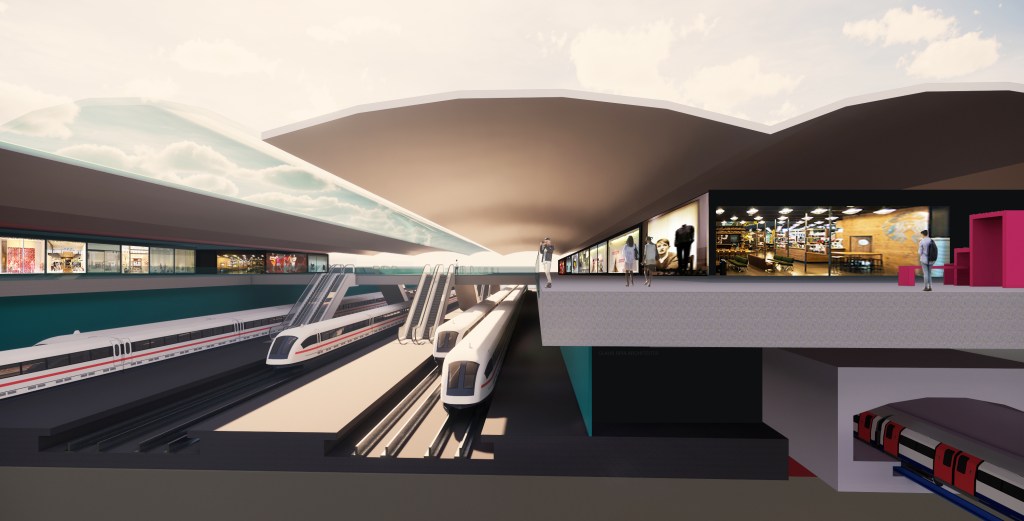
Gleichsam gibt es eine Chance die drei Probleme mit einem neuen Bahnhofsdesign und digitaler Technologie zu lösen, denn die Rückkehr zum Individualverkehr mit dem Pkw kann nicht die Lösung sein, CO2 Probleme zu bekämpfen und die täglichen Staus zu vermeiden. Vielmehr müssen Umbauten und Neubauten von Bahnhöfen erdacht werden, die eine Antwort geben auf die verschiedenen Problemfelder.
Finanziert werden können diese Konzepte nur durch eine Ausweitung und Verbesserung des kommerziellen Anteils einer Retail Street im Bahnhof, damit dem Reisenden und Wartenden -ähnlich wie an einem Flughafen- die Möglichkeit geboten wird, seine Zeit zu nutzen und an einem sauberen und sicheren Ort etwas zu kaufen oder zu sich zu nehmen.
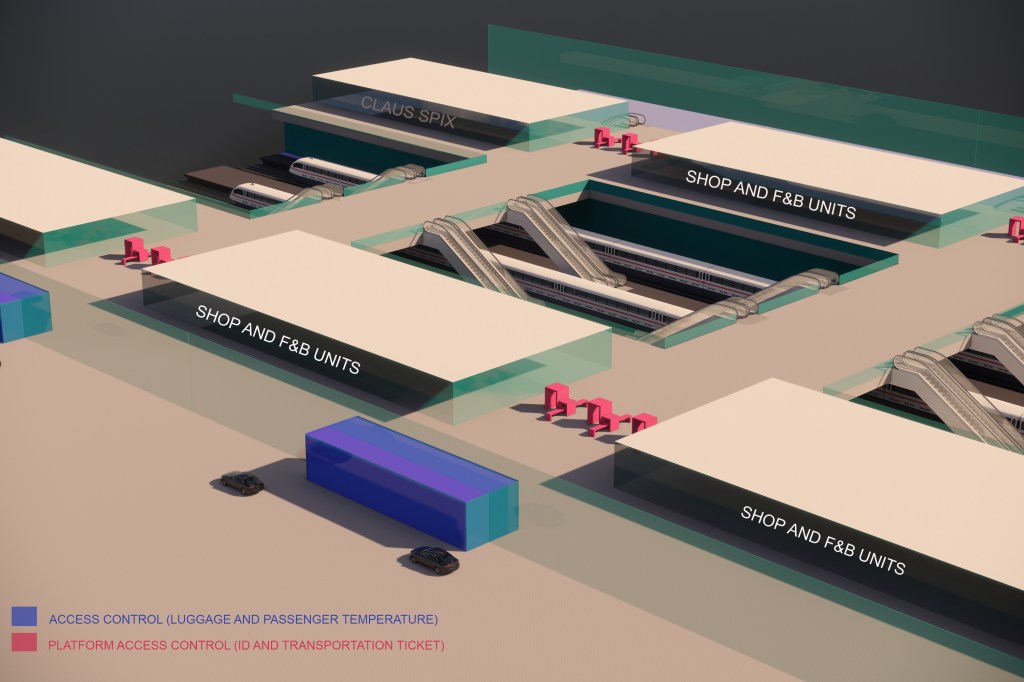
Der hier veröffentlichte Designansatz will Wege aufzeigen, wie Bahnhöfe kommerziell attraktiver gestaltet werden könnten in Kombination mit Eingangs- und Gepäckkontrollen. „Lassen wir Bahnhöfe wieder zu Orten werden, an denen es sich verweilen lässt, saubere Orte der Spitzentechnologie, an denen Eltern mit Kindern sich ohne Sorge aufhalten können. Orte der Begegnung und Orte für Geschäftsabschlüsse – der Bahnhof als Business Hub.“ Claus Spix
At the same time, there is a chance to solve the three problems with a new station design and digital technology, because the return to private transport by car cannot be the solution to combat CO2 problems and avoid daily traffic jams. Instead, it is important to upgrade the old buildings and to think about different new railway station geometries that provide an answer to the various problem areas.
These concepts can only be financed by expanding and improving the commercial share of a retail street in the station, so that the passenger and those waiting, similar to an airport, are offered the opportunity to use their time and buy or eat something in a clean and safe place.
The approach as shown here aims to show ways in which stations could be made more commercially attractive in combination with entrance and baggage controls.
“Let’s convert traditional train stations in clean places of cutting-edge technology where you like to spend an hour, where parents can gather with their children without worry. Places of encounter and for business deals – the station as a business hub.” Claus Spix
 arkollective.com
preciso, adecuado y deseable comentario sobre el futuro de las estaciones ferroviarias. Estoy totalmente de acuerdo con lo escrito por Claus Spix.
LikeLiked by 1 person