
COMMERCIAL MIX & MANAGEMENT THINKING
As mentioned in the previous articles, new trends in society are pushing “place making” towards more demanding and less obvious programmatic combinations. As for retail, we understand that nowadays it involves and binds other types of consumption habits besides those of shopping and entertainment. Functionalities that connect to concepts such as Well-being, Health Care, Sports, Art and Culture, Events, Learning and Education, Green Technology, for example, can add to that sense of being part of a collective system that is concerned with the good of the community.
As always, the choice of the “commercial mix” should come from an in-depth understanding of who your potential customer is and what his needs are. The area where the investment is placed always gives clues on which retail or functions are missing and which are abundant. The management teams should also develop activities that engage more with people’s expectations. A practical example could be to celebrate events that belong to the city or neighborhood where the center is located, instead of only commemorating the Halloween/Christmas/Valentine day uber-commercial dates. Preserving the local spirit and attending to new generational motivations and aspirations – social and technological – seems to us like a good start for re-thinking the “ingredients” to place in retail spaces.

Another aspect we should reconsider in the mainstream commercial areas is the archetypal duality of the Lettable Area spaces, known as GLA (Gross Leasable Area), which tends to be enclosed, and the Public Areas, sometimes organized as corridors and squares, also denominated as malls. We tend to think that the boundaries separating these two functional concepts will blur and be less clear. Retail managers will have to consider the redefinition of relations between these two space concepts. Open air leisure areas, integration with natural and urban public spaces make us foresee more flexible and adaptable retail solutions. As previously mentioned, the new trend set by Pop-Up Stores and similar “spontaneous” venues, makes us believe that shopping will be, in some retail sectors, coming closer to an event or a temporary happening.
(…) the new trend set by Pop-Up Stores and similar “spontaneous” venues, makes us believe that shopping will be, in some retail sectors, coming closer to an event or a temporary happening.
WHERE SHOULD NEW RETAIL PLACES BE IN OUR CITIES?
With most cities in the western and developing world saturated by big scale retail projects we have been witnessing a return of investment to city central areas.
As mentioned before, retail boosts human activity and generates centralities by creating jobs, attracting creativeness and becoming social hubs. Its strength is so big that it can redefine and revalue entire areas of the city. Stimulating investment in retail can be a city planning tool to revitalize less thriving neighborhoods, decaying or obsolete built structures like industrial or transportation buildings, as an example. Retail can also be implemented to upgrade residual and undefined territories and provide identity to uncharacteristic spots in the city. This means that such projects should engage master planners, politicians and other public stakeholders setting an ambitious social logic to the enterprise.
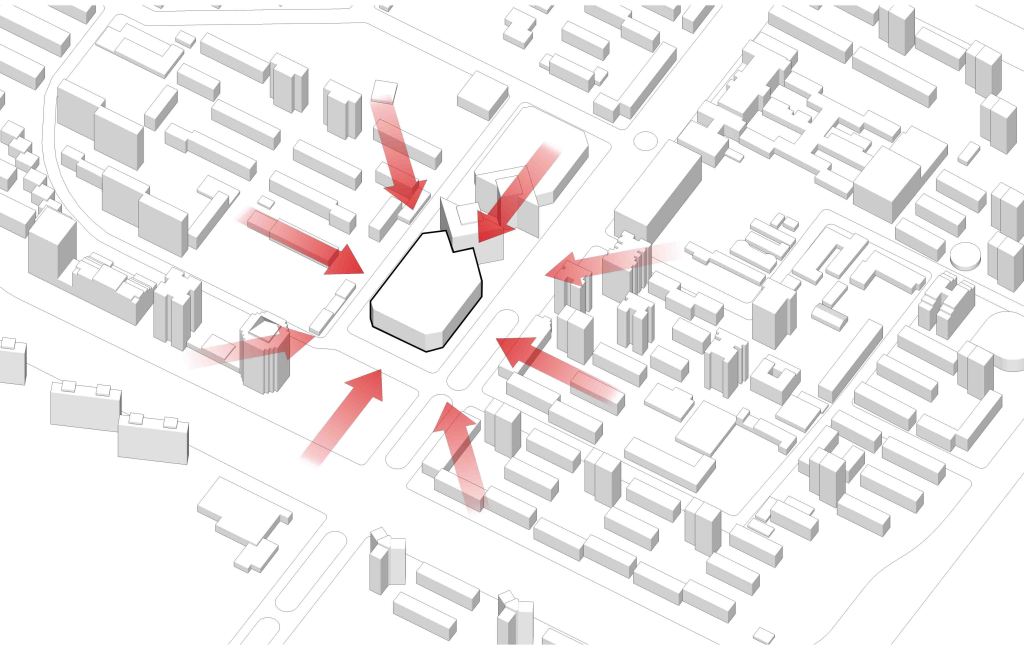
A sustainable investment will consider the multidimensional capacity of retail and use it to intervene in a balanced manner in our cities, considering the social impact and the urban quality for the benefit of the built environment.

RETAIL FOR THE XXI CENTURY, A CONCLUSION
It’s clear for us that to make a difference in the retail business in the coming year’s new strategies have to be built. The approach has to be redesigned in a way that meets a broader range of expectations. The social perception on these types of investments became extremely important and they must be as transparent and ambitious as possible.
Brand and Reputation management must be at the top of considerations in order to refrain some negative perception related with shopping places nowadays.
Environmental and Social sustainability, integration in the urban context, developing diversified programs, bold design ideas and a clear interaction with the smart technologies should become the backbone for a new investment.
Brand and Reputation management must be at the top of considerations in order to refrain some negative perception related with shopping places nowadays.
Comming soon: BUILDING NEW STRATEGIES FOR RETAIL (Thoughts on Retail IV)
 arkollective.com