
DIRECTIONS FOR RETAIL
The new online tools are having a big impact on the consumption habits of customers, with more visibility within the younger generations. The selling strategies are also suffering major changes, using different media channels and supports which rely more on social media then in traditional advertisement.
In order to grasp the new tendencies for retail future trends and in to which place it will fit better, we should observe carefully the changes which the society is going through in recent years and speculate towards where they might take us.

A game changer, new online tools are bringing dramatic changes to consumption habits.
As in every generational leap, young people have different aspirations then their parents. The Millennials and the following group, sociologically referred to as Generation Z, mostly differ from the previous generations due to their proximity and intuitive relation with the internet tools. If the former grew together with the web, the latter was born into it.
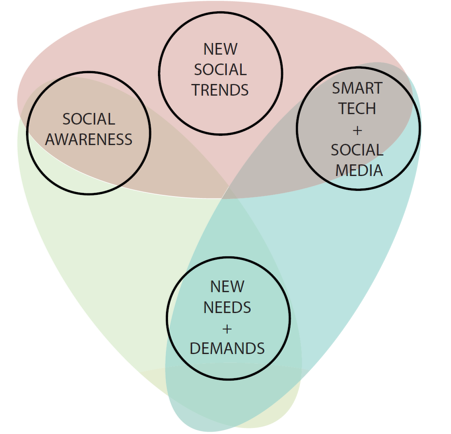
This new condition makes the young especially sensitive to participate in all that integrates smart technologies as well as social media. The constant access to information and opinion making inputs creates a capability of choice, or the illusion of it, never matched before. Buying apps, sharing platforms, Pop-up shops or Pop-up events are some of the new ways of interacting within this changing society.
Along and also thanks to this technological revolution, a new culture of Social Awareness was built on the capability of permanent online communication. New trends which involve community matters make common causes stronger and easier to echo. For example, Shared Economy enables people to spend less alone and share economical burdens. Crowdfunding proposes a totally new way to finance a project based on the support of other individuals or corporate companies. There is a new concern regarding Social Retribution that relates to a pursuit of more balanced ways of being part of society and making usage of global resources. These issues inevitably relate with Climate Change and the emerging awareness of a need for more sustainable ways of life.
A search for Work-Life balance seems also to be one of the main concerns of Millenials and Zoomers (Generation Z). These possible changes include new ways of setting the work place and the way people occupy their free time. The transition between one and the other seems to be fading quickly as we can see in the increasing number of people using Home-Office or the way the Co-Work hubs, with their large social areas for Networking, are designed. Examples like the new Google Campus by BIG & Heatherwick or the Facebook Office building by Frank O. Gehry, show how the old rigid models are giving way to a more flexible and adaptable approach. We believe that, similar to the working space, shopping places are undergoing a modification process that comes mostly from changes in society. New social trends inevitably create new needs and demands.
THE NEW SHOPPING PLACES
In recent years, the mono-functional shopping centers lost their attractiveness due to its old fashioned over-pragmatic principles. The social perception of these spaces became less and less positive due to being associated only with mass consumption. In addition to this, the competition generated by online selling platforms forced retailers to react by investing more money in their shopping outlets focusing on the idea of the “customer experience” as an alternative to the seamless, impersonal purchasing process of E-commerce. This seems logical and appears to aim for a re-connection to the seminal quality of the places where commerce first appeared.
New marketing channels have been designed to connect the physical shop and the virtual one, trying to bring them closer. The omnichannel and O2O marketing strategies or Smart Store concepts are new ways of engaging customers and simultaneously know more about them via big data collection. Hybrids of social media and online selling platforms, these tools reinforce the relation between the client and the retailer by giving direct information on products, offering customized services, better promotions and the best buying experience possible. As an example, the experience can improve by integrating various stakeholders within these virtual platforms enabling the relation of the customer with a brand or a shopping venue to extend beyond their own boundaries. This is all part of the process retail is undergoing of merging technology with physical space.
The role of the Internet of Things (IoT) in retail is getting more and more significant by helping retailers manage better their supplies – smart shelves, for example, can inform if a certain product is missing or going to expire – and collect data from the way shoppers move around their outlets. On the customer side, the IoT focuses more on Digital Signage or Beacons – these devices engage shoppers by notifications via smartphone technology about real-time events, offers or discounts. Digital shop displays and screens using Virtual Reality (VR) to simulate mirrors are some of the IoT technologies being used to showcase a perception of a technologic leap which is still on its first steps.
Back to the quest of how the physical description of the new shopping place might be in the coming years, we believe that the modernist scientific approach of disaggregating core functions between each other has lost part of its significance in the internet age. The constant juxtaposition of contents makes reference to a hyperlinked mindset that deals with many aspects of life simultaneously. In that line of thought, we also believe that the future retail belongs within a space set as a multi-functional platform, housing and accommodating different types of human activity – some commercial, other not. The experiences will be multidimensional, incorporating retail with different venues integrated with new smart retail solutions.
(…) we think that the future retail belongs within a space that is set as a multi-functional platform, housing spaces that can accommodate different types of human activity – some commercial, other not.
Retail spaces will also need to have more dedicated areas for “retail spontaneity”, meaning the physical capacity to welcome Pop-Up events and temporary retail happenings. Flexibility and adaptability are new principles that must be in the mind of designers as shopping becomes more an event then a unidimensional experience as it has been until recent times.
The type of retail and complementary functions should, in part, serve the community where it is placed and make use of apps and initiatives that incorporate principles of the Shared Economy, Shared Causes, Sustainability or Co-working, for boosting the sense of Collective. The new vision for retail space should not embody just the individualistic ideas of buying and pure entertainment but those which contribute to build a better society.

(to be continued…)
 arkollective.com
3 thoughts on “Thoughts on Retail Space II”