

We came across with João Boaventura’s sketch fever in social media during the coronavirus lockdown days.
Accepting one of the many online challenges available nowadays, Boaventura, an architect practicing for more than 25 years, drew one or two sketches per day during 30 days.
Once the 30 day period passed, he kept on drawing as if he was infected with some kind of virus that made him sketch in a compulsive way!

The relation between architects and drawing is very unique. If in a past (not so far) to be an architect you had to be a ‘’good drawer’’, today, with Sketch Up or Archicad and all the software tools for tridimensional simulation, hand sketch became less and less popular. Nevertheless, many architects still use it because they see it as a genuine extension of their brain.
It is most of all a tool to be used in order to materialize the first thoughts of a project or the smallest more detailed parts of it. In other cases, architects see it as a way to understand what it is around them – a famous building and its setting on site or the intricate nature of how a city grew in the natural territory. Some, like me, see it also as a meditative process induced by the focus on the portrayed situation.
As the coronavirus pandemic crisis locked us at home, we all found ways to ‘’escape’’ the bitter taste of home routines. I believe that for Boaventura, the sketch became a strategy to run away from that condition.
We talked with him to understand better why he got into this challenge and what it meant towards his relation with drawing.

You are an architect and as far as I remember you have a very ‘’good hand’’ for drawing… Why did you engage in this challenge first of all?
It all started thanks to two architect friends who convinced me to take part in it. Both are Urban Sketchers, one of them is João Paulo Albergaria, who made several exhibitions and has a very interesting collection of drawings. The other friend, Carlos Amorim Carneiro, is excellent sketching the human figure, among other drawing themes.
Thanks to the confinement period, several hand sketch challenges came out on Instagram. Motivated by my colleagues, I decided to participate on them.
With the motto “a drawing a day, keeps the doctor away” and some good reviews from my friends, I took the challenge of making a Quarantine Hand Sketch diary, during the month of April.
So I started to draw regularly again, driven by the Instagram challenge but also by what I saw around me.

In which way hand sketch is useful for you as a designer?
It’s fundamental, though now mostly dominated by technical drawing and supported by computer assisted programs, like 3D modelling and similar. Drawing always takes part of the creative process, only physical models got replaced by 3D software.
Was it helpful to go through the confinement days in any way?
It helped to create routines. Before the pandemic crisis, I was already home working by myself most of the day, within my own schedule. With the confinement days, my wife and our two kids became part of the daily routine, meal times included, so hand sketching replaced going to the gym every morning, for example. After breakfast, I created this new habit of spending at least one hour hand sketching, making one or two drawings.
There are several sketches from the domestic space, I really like those. How was it, to look in such detail into daily objects, which normally we never pay attention to?
Yes, that’s a fact. It was a challenge not to draw directly from pictures as everything was around me. Many more sketches were drawn but not published on social media.
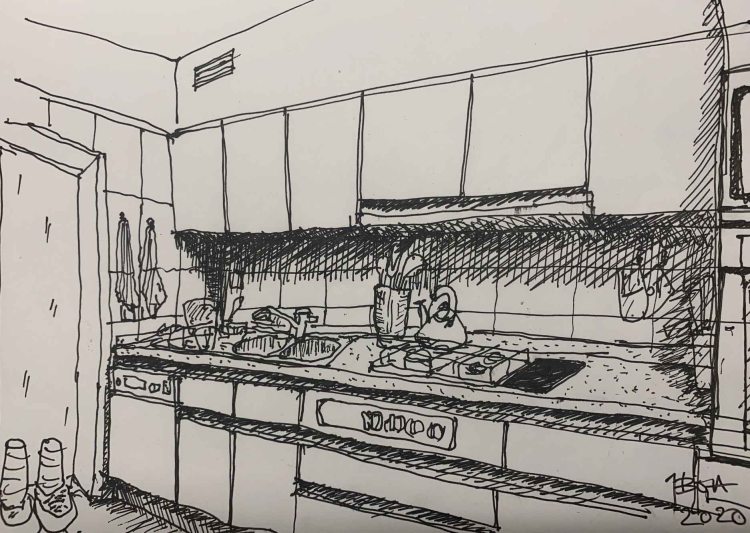
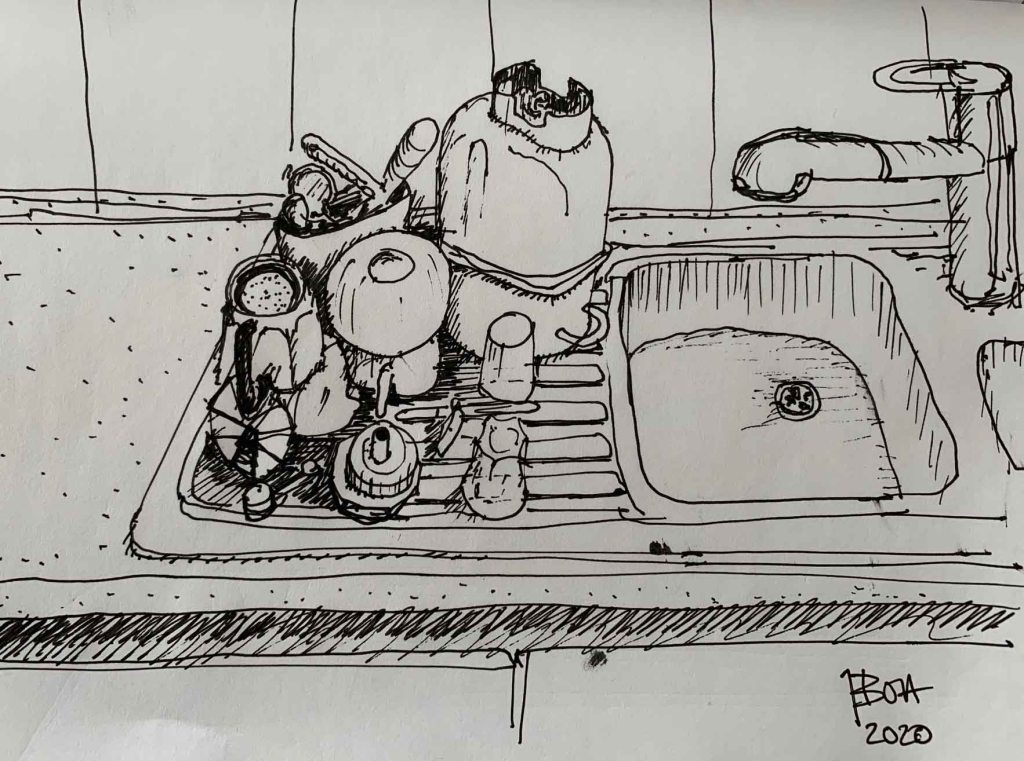
In an architect’s perspective, how did you feel about the capacity of your own apartment to house the whole family for such a long time?
Actually it was a positive surprise. By coincidence, we recently moved to a new apartment and had the feeling that if we had stayed where we were, things wouldn’t have gone as well. Your vital space is essential and having four people together without any conflicts requires generous social areas, a good balcony also helps, as well as that quiet place for each one of us to do whatever we want.
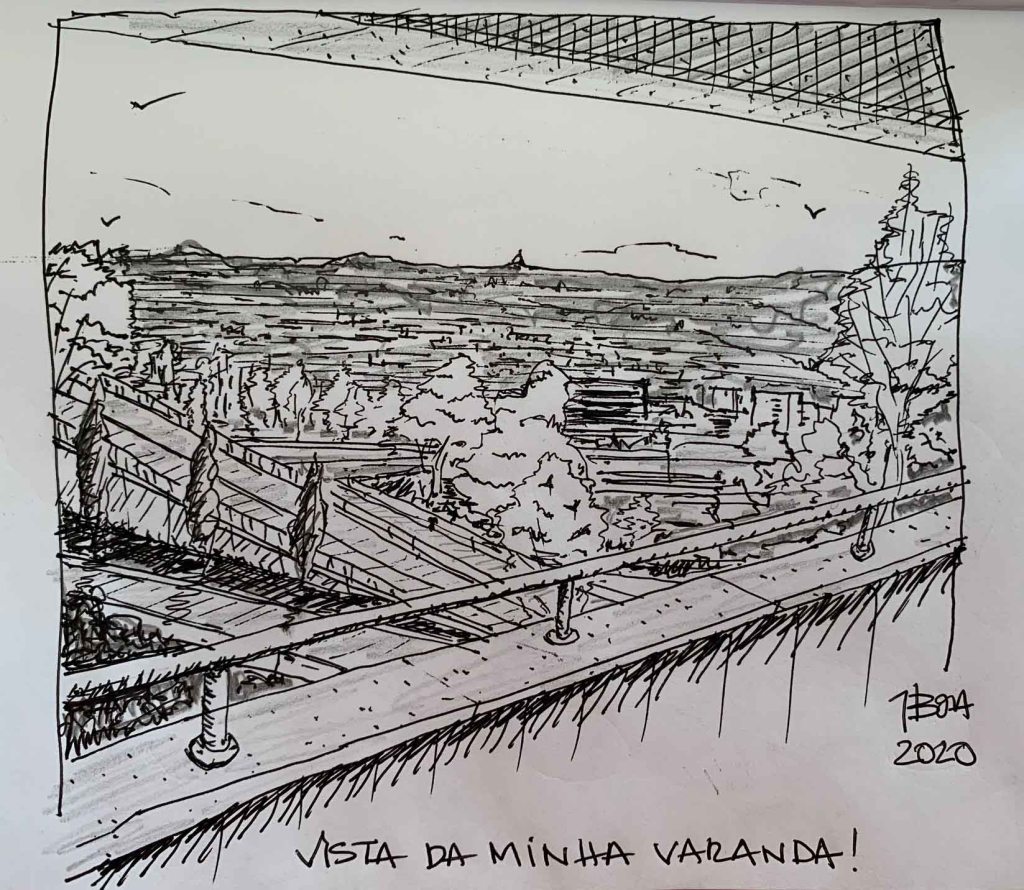
Did you manage to have a happy coexistence or you felt that residential space was pushed to the limits?
As I mentioned before, everything is going reasonably well, but coexistence with teenagers is not easy. Before, during or even after Covid-19 times!!
I defend that adjustments should be made in the near future so that homes become more flexible because we need to be able to do more than sleep, eat and watch TV together. We need to work and have more space for fun. What do you think?
I totally agree. My motto is: ‘’work for a living, don’t live for working’’. I am a food lover, I also like cooking and take pleasure from conversations around the table, with a good wine, cheese and bread…Ups, I am already changing the subject…
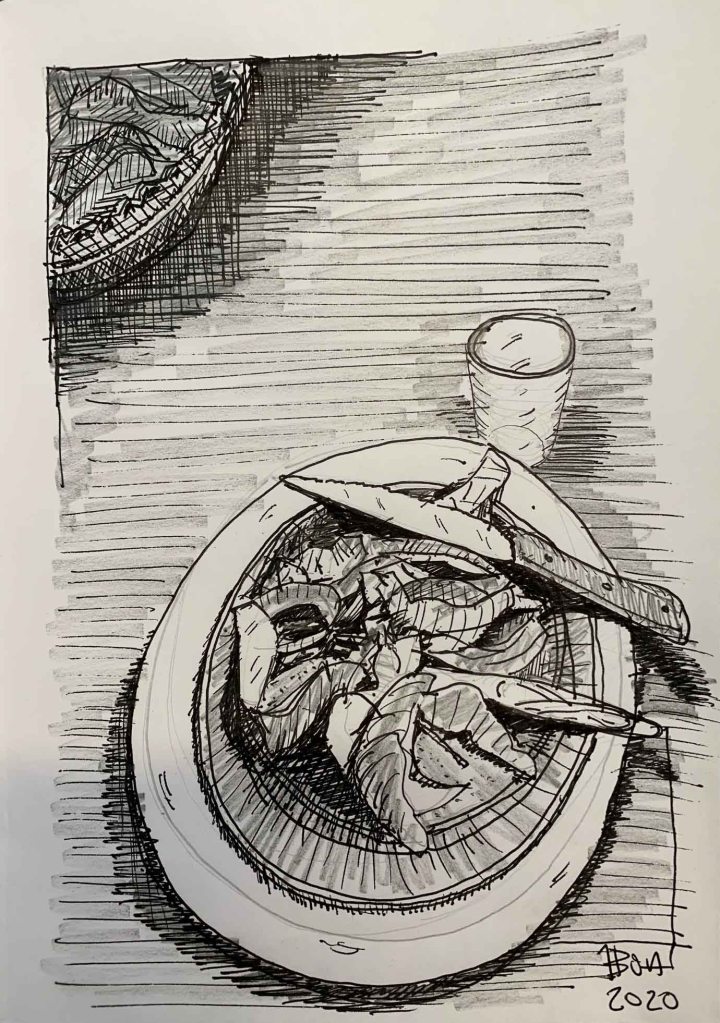
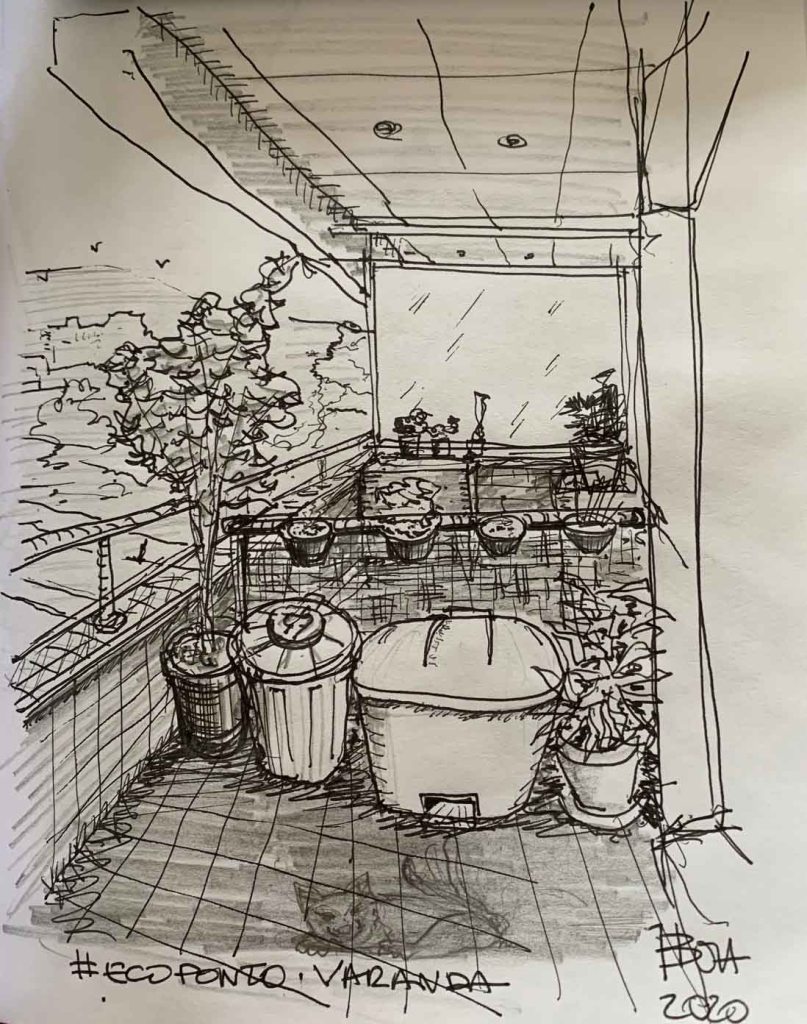
Back to your sketches, you have drawn from pictures and from reality, which ones were more challenging?
Both pose challenges and I feel I still have some trouble giving the right set to the scene.
In the sketches taken from pictures you have a fixed frame but the perspective and proportions are not correct for the human eye. On the other hand, in the sight drawing it’s harder to make the best scene framing. For the latter, I used pencils to establish the main structure and only after I used the pen. For the picture drawings, I experimented two processes, either the slow, detailed version with the graphite pencil or a fast sketch using with pen, resulting in a more fluid and genuine drawing.
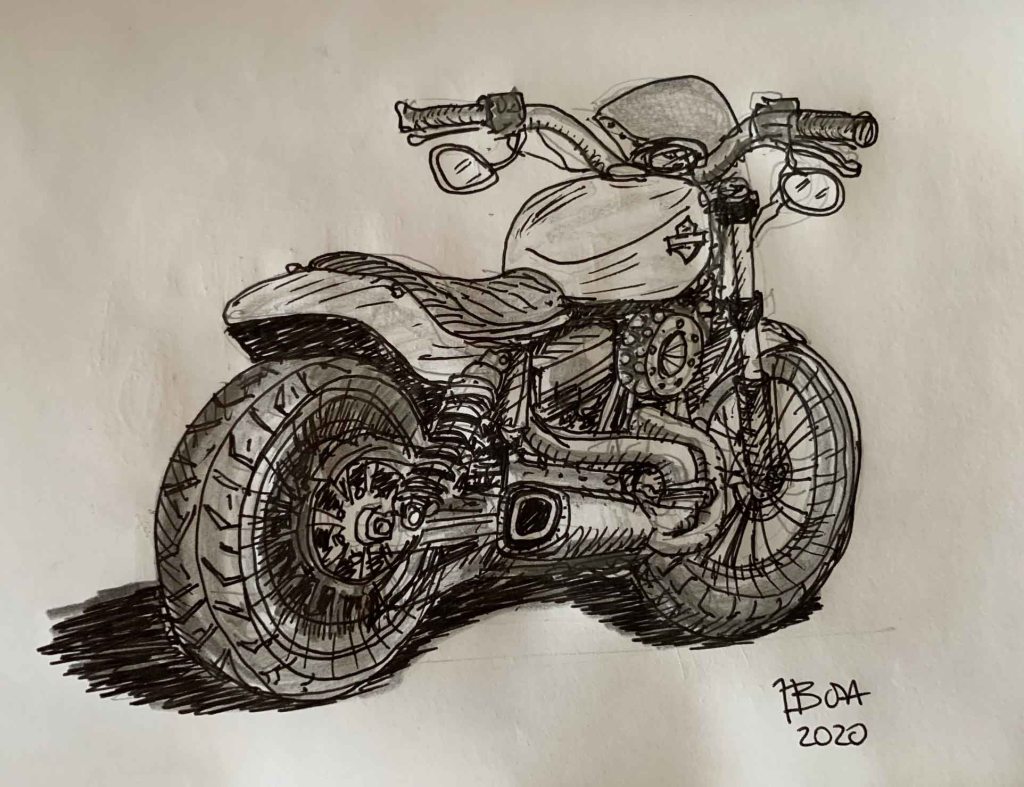
Besides buildings and landscapes you have drawn boats, cars and even bulldozers. From all those which ones were harder and more fun?
Interestingly I had a lot of fun drawing a motorcycle. I had never done it. But it is really hard to draw cars, boats, machines…

Actually one of the first challenges was a barn with a landscape and jeep. In my first sketch, I omitted the jeep and João Paulo Albergaria, who knew about it, asked me: what about the car? To which I replied that I had ‘’parked it in the garage’’ before sketching! For the next sketch of the same image, I took the risk and made a zoom only of the jeep, after that I started with bulldozers, tank trucks and others…


Do you think you are drawing better after this intensive exercise?
I am not sure if my drawings got better but I acknowledge that my posture is different. I took great pleasure from all of them, so much that I keep on doing it. Looking back some are much better than others…
It also depends on the subject. For example, today I tried to draw my cat and it was not easy at all! Talking with my friend and colleague of profession, Carlos Amorim Carneiro, we came to the conclusion that the mythical horse drawing, the human body, the face or the hands require a lot of training and of course, talent.
Would you recommend young architects to exercise their hand sketch skills?
I would indeed. My sketching abilities are fruit of my academic period at the Porto School of Architecture (FAUP). During the first two years in the Drawing discipline, you go out to sketch on the streets, practice human figure drawing with life art models and many other complex exercises. I was lucky that in those two years the school was still in the same building as the Fine Arts School so teachers and experiences were shared between the two institutions. (Note by ARKollective: later the FAUP moved to Alvaro Siza’s famous campus).

Pencils or pens?
Both. My signature is to use them simultaneously in the same drawing.
For the pencil it is easier to correct the lines on the first draft as I don’t press as much and immediately you start getting your shapes and perspective worked out. Maybe I feel more secure with the pencil though I never use a rubber. This was one of the teachings of the sculptor José Grade at the university.
One the challenges I took more fun from was the #creditcarddoodle, which required you to frame your drawing in a credit card sized frame. Due to the small size, I decided to use a very sharp pencil.
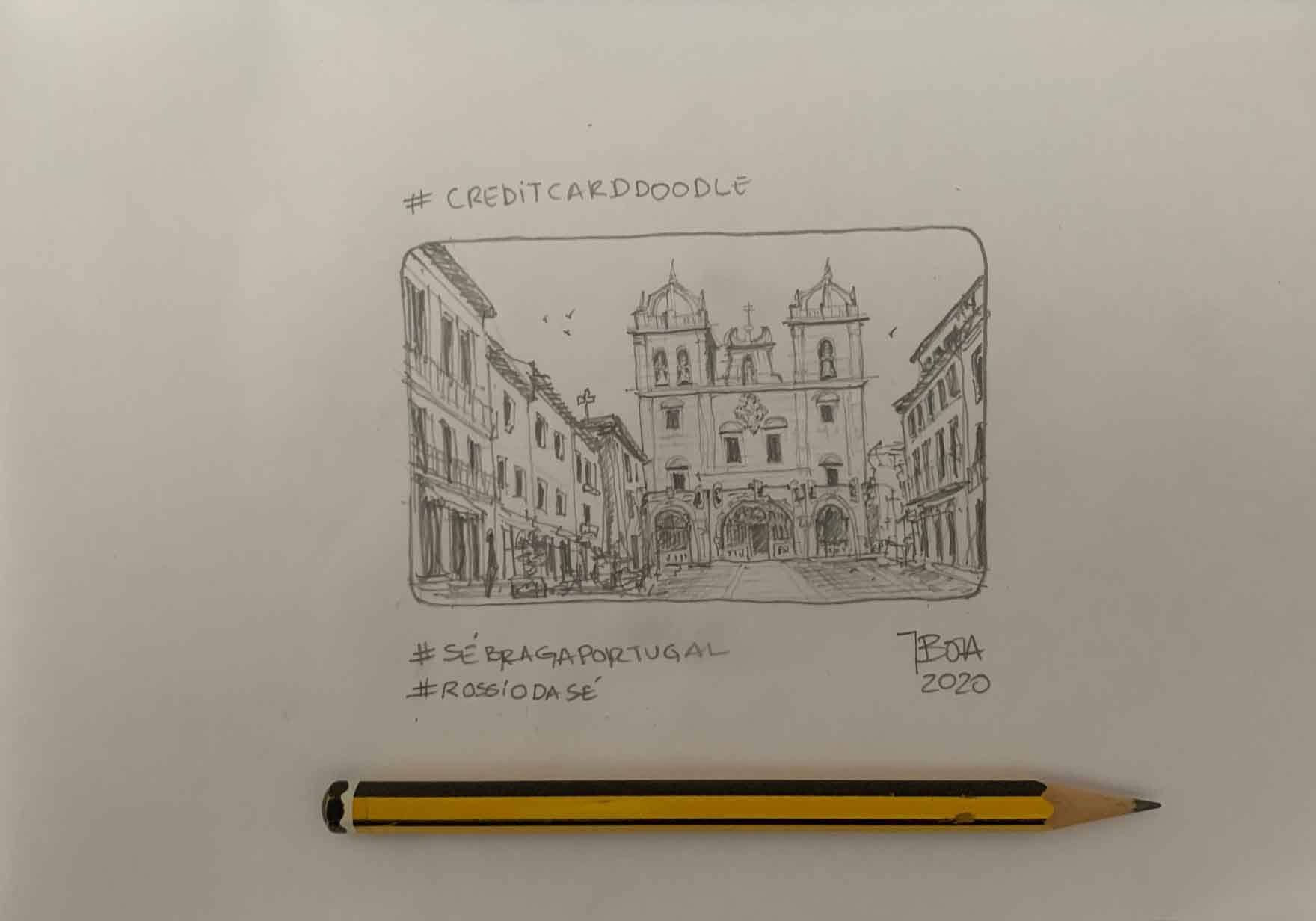

As for the pen, I use whatever I have at hand. As I mentioned before, I tend to use it for fast sketching so I like a pen that doesn’t tie my hand movements. In the pen sketches I also used the pencil to emphasize shadows and give depth. I liked the result and started to do this more often.
Basic gear you use for your hand sketches?
I have been using a simple A5 booklet of normal paper. I think I will ‘’upgrade’’ to A4 once we can go out and draw on the street.
For pencils anything like Ink-gel, Uni-Ball, Bic, Rollerball…
I had a Uni-Ball type of pen that was a victim of the confinement. It couldn’t last the thirty days of the Quarantine Sketch Diary. It was a great extension of my hand with a very fluid stroke.
Now I am using a very basic Ikea gel pen which has a good performance. I also use a rollerball Lamy Safari that was offered to me by the family. My next buy will be a fountain pen and a uniball.

 arkollective.com
9 thoughts on “The Sketch Virus”