
COMMERCE, A MOTOR OF EVOLUTION
Commerce (or trade) has played a very important role in the history of human evolution since ancient times. It is believed that by around 17000 BC, still in the Paleolithic era, men were already making commercial exchanges in New Guinea and further through the centuries, around the globe, this activity only thrived. Beyond profit, this occupation represents a major factor for sociological progress for the human race. Exchange of goods wasn’t the single activity inside the agoras, bazaars or caravanserais, information, experience and knowledge were surely the most valuable assets being traded.
The exchange of goods wasn’t the single activity happening inside the agoras, bazaars or caravanserais, information, experience and knowledge were surely the most valuable assets being traded.

The Neolothic and Chalcolithic proto city of
Çatalhöyük was composed mostly of domestic buildings, but there are large rooms with murals, probably gathering points for the trade of obsidian stone.
Once human settlements became more defined, the evidence of commerce as a central activity for societies is easy to understand in the morphology of towns and cities. Through time, the place where the trade was taking place started to become the central area in the city, sharing this space with other very important activities in the social calendar (pagan and religious). The open air squares, with their weekly fairs or enclosed markets were fixed places, but many of the merchants selling local or imported goods were travelers, bringing news, telling stories, sharing knowledge. Commerce made these places operate like social dynamos, true motors of evolution. It can also be said that they were holistic places for human activity, binding individuals to each other and forging a strong sense of community.
Although many transformations occurred in our cities and trade centers, we believe this quality hasn’t changed much through time.
THE PLACE OF COMMERCE
In the course of time, the location of the commercial areas in our cities began to change. Besides punctual variations, up to the 1800’s the single central core city model prevailed until industrialization and the consequent rapid growth of cities which gave way to a multi-centered urban structure. In this case, the complementary commercial areas that supplied the nearby community orbited the main central core. With the progress of automobile industry mainly in the 20th century, the phenomenon of sub-urbanization grew exponentially, generating the sprawl of the urban fabric towards the periphery of the urban centers. This change in the city structure generated a new commercial model, the Shopping Center or Mall, as it is called in North America, where it was first fully implemented.
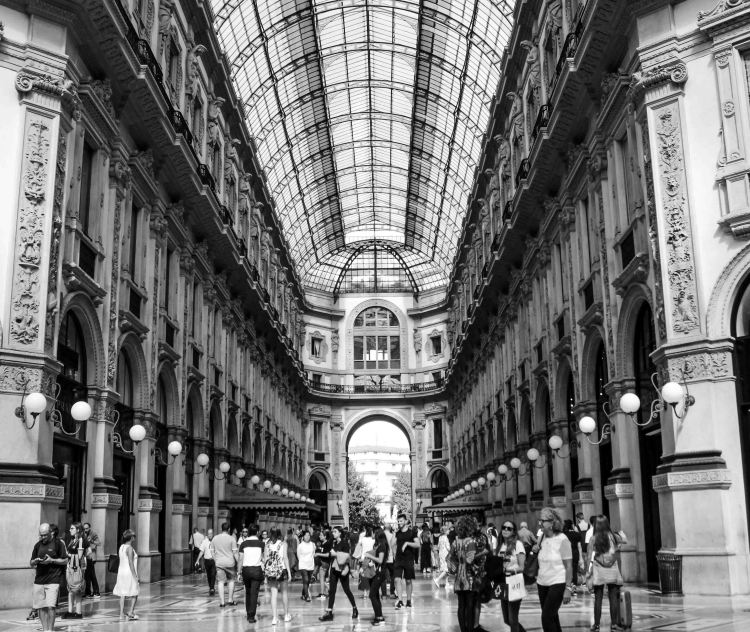
Inspired in the covered Gallery and the Department store type of buildings like the Galleria Vittorio Emanuelle II in Milan and Selfridges in London – the Shopping Center took that model in to a much larger scale. The key was to centralize and sell below one roof a large variety of consumption goods. Its main purpose was to supply very big and rapid growing residential areas which lacked any of the traditional retail outlets of the old city. The Mall replaced the commercial cores of neighborhoods by concentrating shops, and sometimes services, in one single structure, thus not allowing the traditional mixed use city model to coexist in the same area. In time, and mostly due to changes in post war society habits, the city centers became victims of a symptom of periphery due to the great attractiveness of these retail centers.
Trade, commerce or retail is a human activity with great power to create centrality. It has the capacity to create strong synergies which attract people and an enormous range of activities around it.
As the age of the Internet emerged, and with the same logic of “extreme convenience” that the Shopping Centers came to offer, e-commerce arrived to put at stake the large retail spaces spread around cities. Through websites and mobile phone applications we are now able to check, choose, buy and receive at home an enormous variety of goods, avoiding displacement, traffic jams and what started to become a very simplistic approach to human experience offered by the old fashioned shopping outlets.
Nevertheless and independent of the adopted model, trade, commerce or retail is a human activity with great capacity to create strong synergies. It attracts people, generates centrality and can atomize an enormous range of activities around it.
Check out Thoughts on Retail Space II
 arkollective.com